Private jet emissions: what drives them and who is accountable
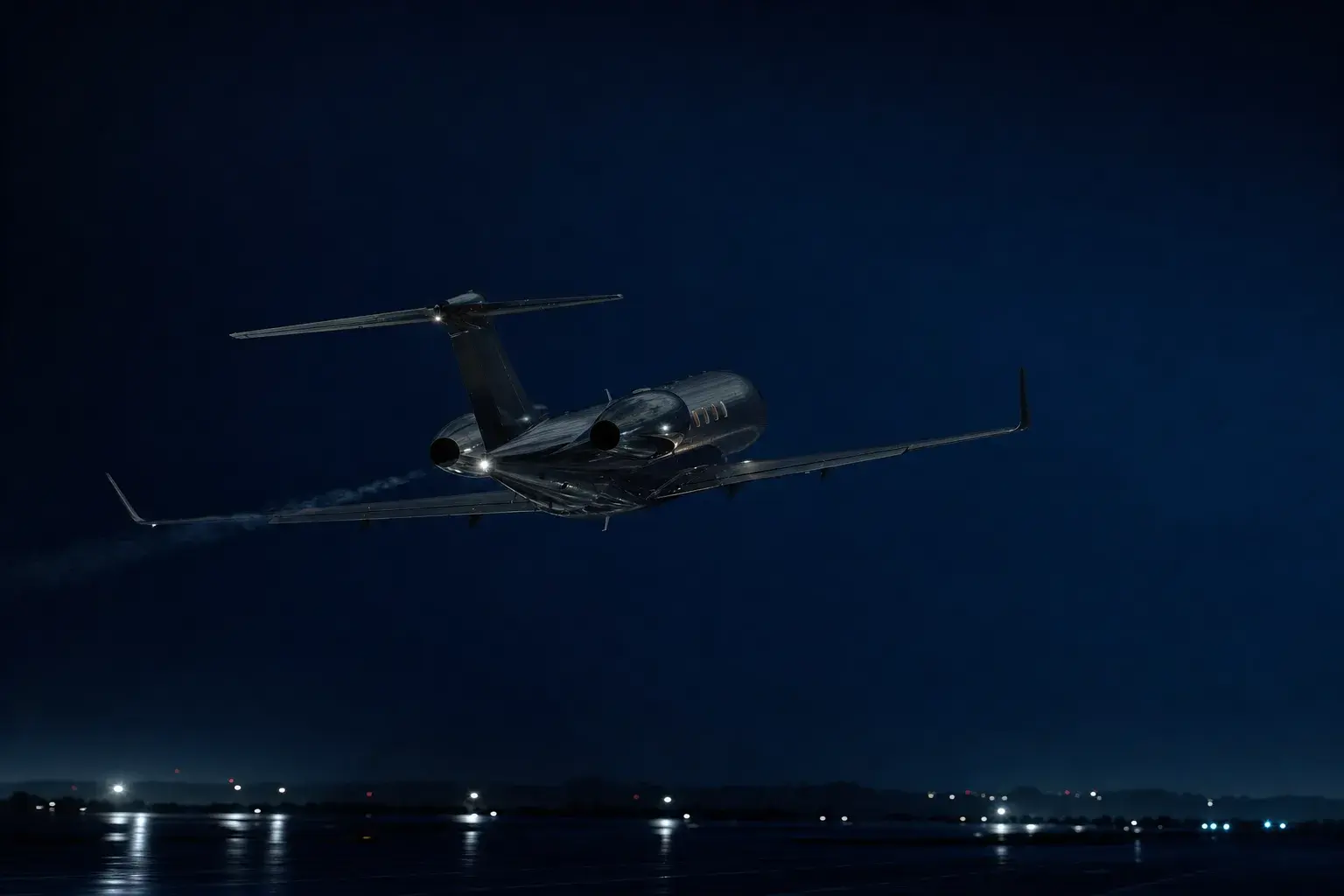
There is no single figure for private jet emissions. There is one for a specific aircraft on a specific route. JETAURA arranges private jet charter flights through a network of aviation partners and operators, and we do not fly the aircraft ourselves. That position is useful for this topic. It lets us explain what drives the emissions of a single flight and which parts of it you can influence.
What determines private jet emissions per flight?
Private jet emissions per flight depend on how much fuel the flight burns. According to the UK Department for Transport, the standard approach is to "take the distance or duration of the flight, estimate how much fuel was burnt, and estimate emissions produced from burning that much fuel." Fuel burn depends on the aircraft and how the flight is operated.
Two details in the same technical note matter for charter. First, "different phases of a flight require different modes of engine thrust and therefore different fuel burn". Take-off and climb are not the same as cruise. Second, "different aircraft burn fuel at different rates depending on their size, age and the fuel efficiency of their engines."
That is why we do not print a figure for "a private jet", and we are wary of articles that do. Some of these factors are set in your request, others by the operator, as the table below shows.
The factors behind private jet emissions, and who decides them
| Factor | What it changes | Who decides |
|---|---|---|
| Distance or flight duration | How much fuel the flight needs | You, through route and airports |
| Aircraft size | Fuel burn rate | The specific aircraft depends on availability and operator |
| Aircraft age and engine efficiency | Fuel burn rate | The operator whose aircraft is available |
| Flight phases | Thrust and fuel burn differ between take-off, climb and cruise | The operator's flight planning |
| Positioning of the aircraft | A flight without passengers to or from your departure airport is a flight too | Availability and the operator's schedule |
A clear passenger count and a clear route make it easier to match the class to the trip.
Who is responsible for private jet emissions under EU ETS and CORSIA?
Under the EU Emissions Trading System, the obligation sits with aircraft operators. The European Commission states that "all airlines operating in Europe, European and non-European alike, are required to monitor, report and verify their emissions, and to surrender allowances against those emissions." Which rule applies depends on the operator.
The Commission also lists thresholds that change how the rules apply. A commercial air transport operator can fall under a de minimis rule if it operated fewer than 243 flights per consecutive four-month period or emitted less than 10,000 tonnes of CO2 a year. Non-commercial operators whose flights emit less than 10,000 tonnes of CO2 per year count as small emitters. For them, the Commission describes a simplified way of monitoring. That is not the same as an exemption.
CORSIA is a scheme of the International Civil Aviation Organization (ICAO). According to the European Commission, CORSIA "aims to stabilise CO2 emissions at 2020 levels by requiring airlines to offset the growth of their emissions above these levels."
We explain the framework here. We do not give legal advice on it. The same division of duties shows up again with sustainable aviation fuel.
What sustainable aviation fuel changes, and what it does not
According to EASA, "the ReFuelEU Aviation Regulation has set a minimum supply mandate for Sustainable Aviation Fuels (SAF) in Europe, starting with 2% in 2025 and increasing to 70% in 2050." For private jet emissions, the word that matters is supply. The mandate is aimed at fuel supply, not at the passenger's booking.
EASA also notes that SAF "have the potential to offer significant CO2 and non-CO2 emissions reductions on a lifecycle basis compared to conventional jet fuels."
What this means in practice for your charter request
Suppose a family of four tells us that private jet emissions matter to them. They give their departure and destination airports, the date, the exact passenger count and their luggage. At the start, they also ask whether their flight could use sustainable aviation fuel. We check available aircraft against these details and come back with suitable options. The fuel question is one the operator answers, not us. And none of the options comes with a promise about the emissions result.
Checklist for your request:
- Departure and destination airport, and whether a nearby alternative would work for you
- Date, and whether it is flexible
- Exact number of passengers
- Luggage, including sports equipment
- Any wish regarding the aircraft, stated at the start
What depends on the operator, not on your request:
- Which specific aircraft is available, and its age and engines
- Flight planning
- Positioning of the aircraft
- Whether a flight can use sustainable aviation fuel
Our selection criteria include availability, price, aircraft type, range, passenger capacity and routing. How the classes differ in principle is covered in our FAQ on choosing an aircraft. You do not need to find the right aircraft yourself. The same openness applies to price: you receive a quote tailored to your trip, not a flat "from" promise. What we cannot do is promise a specific emissions outcome, because the flight itself is carried out by the respective operator.
A note on empty legs. Whether an empty leg changes a flight's emissions is answered in the questions below. How empty legs work in general is explained on our empty legs page.
If you are still weighing whether to fly private at all, private jet vs first class covers what else changes.
Frequently asked questions
Do private jet operators have to account for their CO2 in the EU?
Yes, in principle. According to the European Commission, all airlines operating in Europe must monitor, report and verify their emissions and surrender allowances against them under the EU ETS. Thresholds exist for commercial operators with few flights or low emissions, and non-commercial small emitters use simplified monitoring. Which rule applies depends on the operator.
Can I ask for a flight on sustainable aviation fuel?
You can state any wish in your charter request, and it is best to do so at the start. Whether a specific flight can use sustainable aviation fuel depends on the operator. The EU's ReFuelEU mandate, as described by EASA, is a supply obligation on fuel suppliers, not a guarantee for an individual flight.
Does an empty leg lower a flight's emissions?
We cannot say that it does. An empty leg arises, for example, when a private jet returns without passengers to its next base after a flight. It is tied to the operator's existing schedule and can be cancelled or moved. JETAURA has no verified figure on the emissions of empty legs, so we make no claim about them.
Does the aircraft class affect private jet emissions?
Yes. The UK Department for Transport notes that aircraft burn fuel at different rates depending on their size, age and engine efficiency. Choosing a class that fits your passenger count and route is therefore relevant. The exact effect depends on the specific aircraft and operator, so no general figure applies.
Send us the details of your flight
About the author Written by the JETAURA Aviation Team. JETAURA arranges private jet charter flights through a network of aviation partners and operators. We check suitable aircraft for each request and put together matching options; the flight itself is carried out by the respective operator.
Sources
- UK Department for Transport: Technical note: A comparison of aviation emissions methodologies, retrieved 15 September 2026
- European Commission: Reducing emissions from aviation, retrieved 15 September 2026
- European Commission: Aircraft operators and their administering countries, retrieved 15 September 2026
- EASA: Sustainable Aviation Fuels, retrieved 15 September 2026