Private jet turbulence: what causes it, who decides and what it means for you
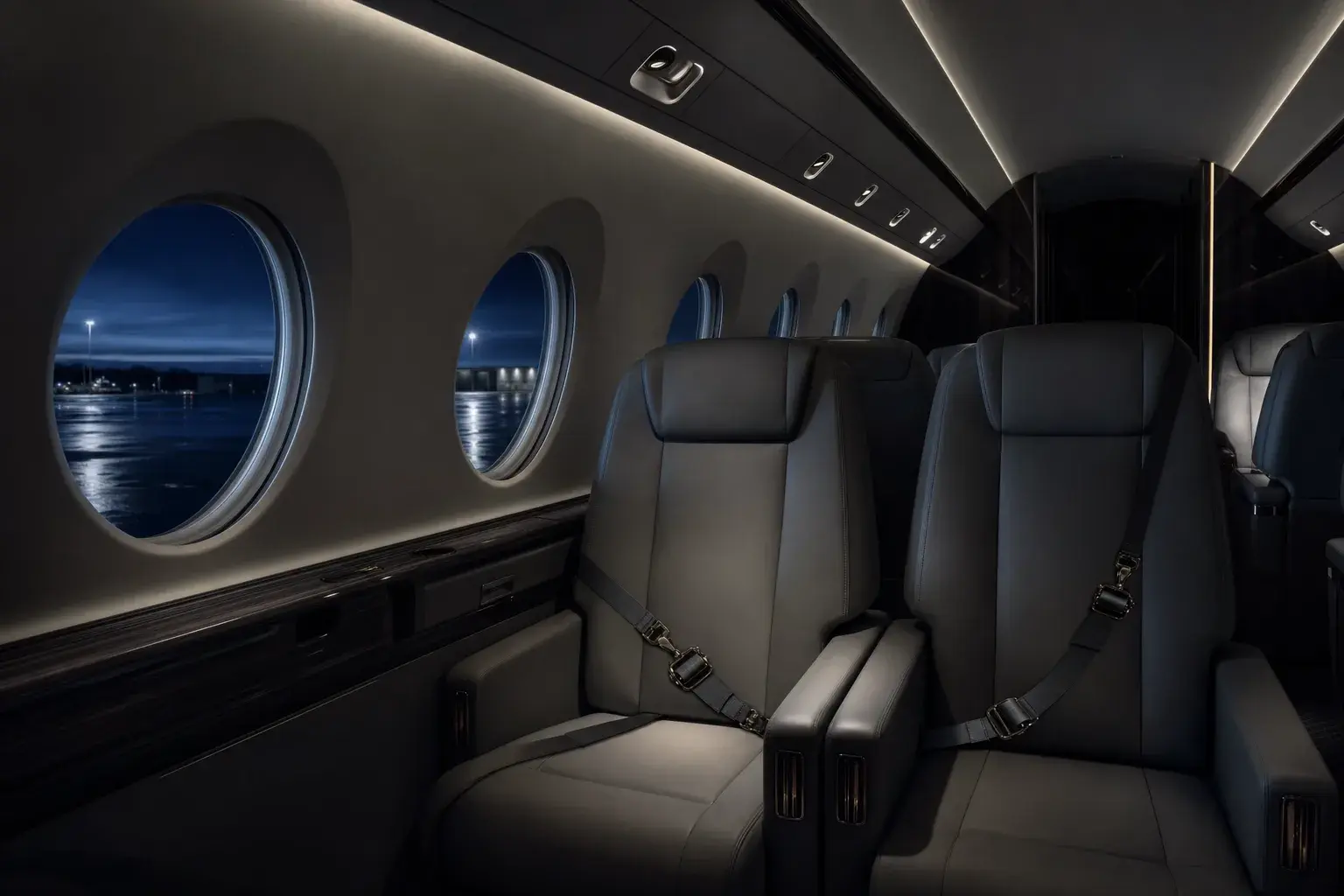
The coffee moves before you do. Then the seat-belt sign comes on. Private jet turbulence deserves a straight answer. JETAURA arranges private jet charter flights; the flight itself is carried out by the operator and its crew. So this article does not tell you that a private jet "avoids" turbulence. It explains where turbulence comes from, how pilots grade it, and which part of it you can influence yourself.
Do you feel more turbulence in a private jet?
Many sites claim that private jets handle turbulence better, or worse, than airliners. We have not found a primary source from an aviation authority that settles this in general terms, so we do not make the claim either way. How a flight feels depends on the aircraft, the route, the altitude and the weather on the day.
What can be stated with sources is where turbulence comes from. That is the more useful starting point anyway.
What causes turbulence
Turbulence is air that does not move smoothly. The National Weather Service names several sources, and the FAA adds two more.
| Type | What happens | Source |
|---|---|---|
| Thermal / convective | "Turbulence can also be expected on warm summer days when the sun heats the earth's surface unevenly." | NWS |
| Mechanical | "Friction between the air and the ground, especially irregular terrain and man-made obstacles, causes eddies and therefore turbulence in the lower levels." | NWS |
| Mountain wave | "Mountain waves are turbulent eddies that are found downwind from mountain ridges." | NWS |
| Clear air turbulence (CAT) | High level turbulence, "normally above 15,000 feet ASL" (above sea level), not associated with cumuliform cloudiness, including thunderstorms | FAA AIM |
| Wake turbulence | "Every aircraft generates wake turbulence while in flight." | FAA AIM 7-4-1 |
How pilots grade turbulence
The FAA's Aeronautical Information Manual sets out intensity levels for pilot reports. Each level is described partly by what happens to the people on board. Three of them, quoted from the manual:
| Intensity | Effect on occupants (FAA AIM, TBL 7-1-11) |
|---|---|
| Moderate | "Occupants feel definite strains against seat belts or shoulder straps." |
| Severe | "Aircraft may be momentarily out of control." "Occupants are forced violently against seat belts or shoulder straps." |
| Extreme | The aircraft is "practically impossible to control. It may cause structural damage." |
Notice what the FAA uses as its measure: the seat belt. Even the moderate level is described through it, which is where the next section picks up.
Why does the seat belt matter in turbulence?
The seat belt keeps you in your seat when the aircraft moves suddenly. According to the NTSB, passengers accounted for 21% of those seriously injured in the turbulence-related accidents it studied, and nearly all of them were unbelted. The NTSB data covers US airline operations, not private charter flights.
We do not have comparable figures for private charter, and we will not borrow the airline numbers to suggest any. The point that carries over to private jet turbulence is simpler. A belt that is fastened whenever you are seated costs you nothing.
What this means in practice for your charter request
When it comes to private jet turbulence, JETAURA does not fly the aircraft, and we do not decide on routing or altitude. Our part comes earlier: we check available aircraft, send you suitable options and, after your confirmation, coordinate the next steps with the operator.
How crews plan around turbulence
The FAA issues SIGMETs, advisories that cover, among other things, "severe or extreme turbulence or clear air turbulence (CAT) not associated with thunderstorms." The FAA also notes: "Any convective SIGMET implies severe or greater turbulence, severe icing, and low-level wind shear." Pilots add their own reports from the air.
What the crew does with that information is their decision: the route, the altitude, the timing and when the seat-belt sign goes on. Altitude is not a guarantee. We explain the limits of altitude in why private jets fly higher.
What you can do before the flight
Checklist for your enquiry
- Departure point, destination, date and number of passengers. The basis of every enquiry.
- Children or infants on board. Requirements can vary by age, route and operator.
- How flexible your timing is. Weather can change the plan on the day.
- What matters to you in the cabin. Aircraft differ, and so does what an operator can offer on board.
An illustration, not a real booking. Four passengers send an enquiry: departure point, destination, date, one child on board. We check available aircraft and send suitable options. After confirmation, we coordinate the next steps with the operator. On the day, a SIGMET covers part of the route. The crew decides on routing, altitude and the seat-belt sign.
What stays with the operator and crew: the flight plan, the altitude, any change to timing due to weather and every instruction in the cabin. If you want to know who that operator is and how to check them, read how to check the operator behind your charter.
Frequently asked questions about private jet turbulence
Can a private jet fly above turbulence?
Not reliably. Cruising altitude does not rule it out: the FAA describes clear air turbulence as occurring at high level, normally above 15,000 feet, and without cloud. Whether a different altitude would be smoother on a given flight is a decision for the crew and depends on the conditions that day.
What is clear air turbulence?
Clear air turbulence is turbulence at high altitude that is not linked to cumulus clouds or thunderstorms. According to the FAA, it normally occurs above 15,000 feet. Pilots rely on advisories such as SIGMETs and on reports from other pilots.
What is wake turbulence?
Wake turbulence is the disturbed air an aircraft leaves behind as it flies. According to the FAA, every aircraft generates it, as a result of producing lift: two counter-rotating vortices trailing behind the aircraft.
Should you stay belted when the seat-belt sign is off?
Keeping your belt fastened while seated is a sensible habit on any aircraft. The FAA describes even moderate turbulence by the strain passengers feel against their seat belts. Crew instructions on a private jet come from the operator's crew and always take priority.
Looking for a flight?
Private jet turbulence is not something a broker can promise away. You will not get a flat "from" price from us either, but an offer tailored to your trip. What we can do is find the right aircraft for your trip and pass on what matters to you. Open questions about charter in general are answered in our FAQ.
About the author This article was written by the Aviation Team at JETAURA. JETAURA arranges private jet charter flights through a network of aviation partners and operators. We review suitable aircraft for each enquiry and put together matching options; the flight itself is carried out by the operator.
Sources (retrieved 15 September 2026)
- FAA: Aeronautical Information Manual, Chapter 7, Section 1 (7-1-6 Inflight Aviation Weather Advisories; 7-1-21 PIREPs Relating to Turbulence, TBL 7-1-11), edition of 20 February 2025
- FAA: Aeronautical Information Manual, Chapter 7, Section 4 (7-4-1 Wake Turbulence)
- NOAA National Weather Service, Houston/Galveston: Turbulence (undated training page, as of 15 September 2026)
- NTSB Safety Compass: Flight attendants continue to be seriously injured in turbulence (13 November 2023, on NTSB safety research report SS-21/01, US Part 121 air carrier operations)
- FAA — Aeronautical Information Manual, Chapter 7 Section 1 (7-1-6, 7-1-21 TBL 7-1-11); geprüft via faraim.org, Ausgabe 2/20/25
- FAA — Aeronautical Information Manual, 7-4-1 Wake Turbulence; geprüft via faraim.org
- NOAA National Weather Service, Houston/Galveston — Turbulence (undatiert, Snapshot 2026-09-15)
- NTSB Safety Compass (Jana Price, PhD), 13.11.2023 — zu NTSB/SS-21/01, Part 121