Why do private jets fly higher? The physics and the rules behind it
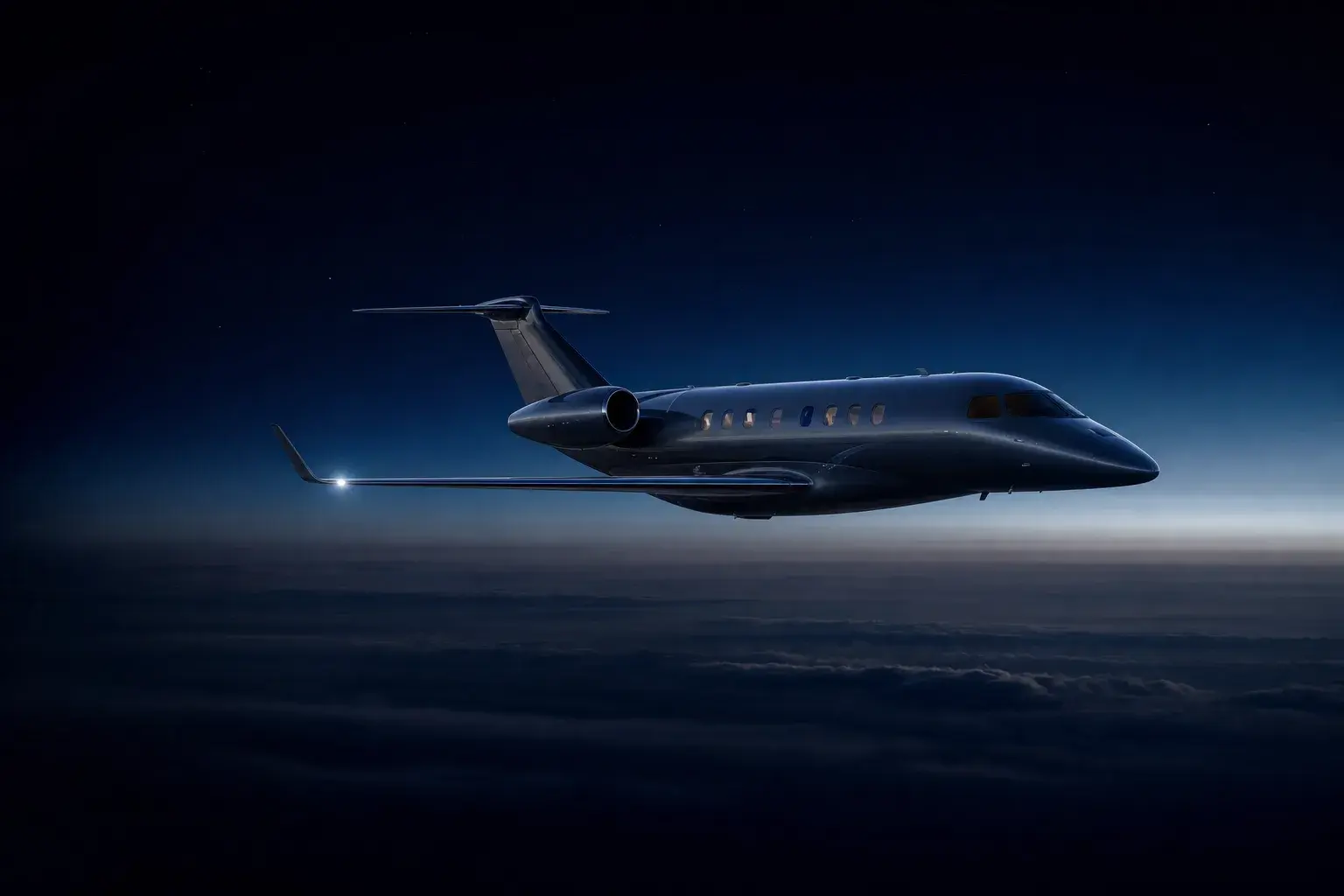
Nobody books a charter flight by altitude. Still, "why do private jets fly higher" is one of the first questions people ask once they look into private aviation. The honest answer has less to do with luxury than with air, weather and airspace rules. JETAURA arranges private jet charter flights through a network of aviation partners and operators. We do not fly the aircraft ourselves. Heights depend on the aircraft, so this article quotes no private jet cruising altitude and does not claim that every private jet flies higher than an airliner.
So why do private jets fly higher?
Altitude matters for any jet because air thins as you climb. According to NASA, halving air density halves drag, and it halves lift as well. NASA also places most of Earth's weather in the lowest layer of the atmosphere. How high a specific private jet flies depends on the aircraft and the operator carrying out the flight.
Thinner air: less drag, but also less lift
NASA's Glenn Research Center states the basic point plainly: "In the atmosphere, air density decreases as altitude increases." Its guide adds that lift and drag both depend linearly on the density of the air. Halve the density and you halve the drag.
An aircraft moving through thinner air meets less resistance.
The same NASA sentence holds the catch. Halving the density also halves the lift, so the wing has less air to work with. Altitude is a trade-off.
Above most of the weather, but not all of it
NASA Science describes the troposphere, the lowest layer of the atmosphere, in one line: "Most of Earth's weather happens here, and almost all clouds that are generated by weather are found here." According to NASA, this layer extends on average about 12 kilometers (7.5 miles) above the surface.
Above it lies the stratosphere. NASA calls it "nearly cloud- and weather-free" and notes that it is "the highest part of the atmosphere that jet planes can reach."
Two words in those quotes deserve attention: "most" and "nearly". NASA does not promise that private jets fly "above the weather", and neither do we. The height of the troposphere is an average.
That leaves the third reason: how airspace is organized.
Airspace: the RVSM band between FL290 and FL410
EUROCONTROL writes 29,000 feet as "FL 290". Reduced Vertical Separation Minima, or RVSM, were introduced to "reduce the vertical separation minima between aircraft from 2,000ft to 1,000ft above 29,000ft (FL 290)". The change created six additional flight levels between 29,000 and 41,000 feet, and EUROCONTROL puts the resulting gain in airspace capacity at up to 20 %.
One detail we like: according to EUROCONTROL, RVSM went live at 00:01 UTC on 24 January 2002, across 41 States in the same minute. A winter night, just after midnight, and the vertical map of the sky over those States was redrawn.
Cabin pressure, oxygen and separation: the rules at altitude
The table collects what the sources say about air density, cabin pressure, oxygen and separation.
| Topic | What the source says | Source |
|---|---|---|
| Air density | Lower density reduces drag, and it reduces lift in the same proportion | NASA Glenn Research Center |
| Cabin pressure | Pressurized cabins of transport-category aircraft must provide a cabin pressure altitude of no more than 8,000 feet in normal operation, with exceptions defined in the rule | 14 CFR § 25.841(a) |
| Pressurization failure | If certification above 25,000 feet is requested, occupants must not be exposed to cabin pressure altitudes above 15,000 feet after any probable failure of the system | 14 CFR § 25.841(a)(1) |
| Oxygen above FL250 | US-registered aircraft with a pressurized cabin need at least a 10-minute supply of supplemental oxygen for each occupant | 14 CFR § 91.211(b)(1)(i) |
| Oxygen above FL350 | One pilot at the controls must wear and use a sealed oxygen mask. Up to FL410, this does not apply if two pilots at the controls each have a quick-donning type of oxygen mask | 14 CFR § 91.211(b)(1)(ii) |
| Vertical separation | 1,000 feet between aircraft above FL290 under RVSM | EUROCONTROL |
The four rows from the Code of Federal Regulations are US rules. Part 25 is the FAA's airworthiness standard for transport-category airplanes. Section 91.211 covers civil aircraft of US registry. Neither applies automatically to aircraft certified or registered elsewhere. We quote them because the text is public and precise, and because it shows the principle: at altitude, the cabin is an engineered environment. What cabin altitude means in detail is covered in private jet cabin altitude.
What this means in practice for your charter request
You do not need to know a flight level to request a private jet.
Say you ask whether the jet will fly above the weather. We cannot promise that. What the enquiry needs first is the trip itself. With those details, we check available aircraft, and you receive suitable options and an individual offer.
The altitude of the flight is not something JETAURA decides. The flight is carried out by the respective operator. Aircraft type, range, passenger capacity and routing are among the criteria that shape the selection of options. You do not have to find the right aircraft yourself.
The aircraft classes we arrange run from light jets, suited to shorter routes and smaller groups, to ultra long range jets, built for very long international connections.
Checklist: what helps before you send a request
- Departure airport or city
- Destination
- Travel date, and whether it is flexible
- Number of passengers
- Luggage, including sports equipment
- Wishes on board, such as catering or Wi-Fi (both depend on the aircraft and operator)
Share these wishes with your request. If you want to know what happens on the ground before take-off, read what an FBO is. For the wider comparison with scheduled flights, see how a private jet compares with first class. Questions on booking, luggage and services on board are answered in the JETAURA FAQ.
Frequently asked questions
Is flying higher always better?
No. According to NASA, lower air density reduces drag, but it reduces lift in the same proportion. Altitude is therefore a trade-off, and the cruising level of a specific private jet flight depends on the aircraft and on the operator carrying out the flight.
What does FL290 mean?
In EUROCONTROL's description of RVSM, FL290 stands for 29,000 feet. According to EUROCONTROL, Reduced Vertical Separation Minima went live in 41 States on 24 January 2002 and reduced the vertical separation between aircraft above FL290 from 2,000 to 1,000 feet.
Do private jets carry oxygen for passengers?
It depends on the aircraft and the rules it is registered under. For US-registered civil aircraft with a pressurized cabin, 14 CFR § 91.211 requires at least a 10-minute supply of supplemental oxygen for each occupant above FL250, for use if a descent becomes necessary after a loss of cabin pressurization.
Planning a flight? The choice of aircraft starts with your trip.
Sources (retrieved 15 September 2026)
- NASA Glenn Research Center: Density Effects
- NASA Science: Earth's Atmosphere: A Multi-layered Cake
- EUROCONTROL: Celebrating 20 years of Reduced Vertical Separation
- eCFR: 14 CFR § 25.841 Pressurized cabins
- eCFR: 14 CFR § 91.211 Supplemental oxygen
About JETAURA Written by the JETAURA aviation team. JETAURA arranges private jet charter flights through a network of aviation partners and operators. We check suitable aircraft for each request and put together options. The flight itself is carried out by the respective operator.